The Autonomous Administration of North and East Syria is under existential attack from Turkey and their mercenaries. This has been a week of broken ceasefire agreements and of difficult negotiations. The Administration has put forward proposals and compromises, but is ready for total resistance, while Erdoğan has restated his neo-Ottoman ambitions. The United States is in the middle, but political solutions are not helped by the lack of public awareness and so of public pressure.
No one can be in any doubt of Recep Tayyip Erdoğan’s imperial and neo-Ottoman ambitions. No-one can say that they have not been warned. On Wednesday, speaking at a national scientific award ceremony, Erdoğan declared, “Every incident that has occurred in our region, especially in Syria, reminds us of this fact: Turkey is bigger than Turkey itself. As a nation, we cannot limit our horizon to 782 thousand square kilometres, ” And he referenced the centenaries of two key Ottoman battles. This isn’t the first time that he has made his ambitions clear, but with the Turkish military readying for an all-out attack on Kobanê and for the annihilation of the Autonomous Administration of North and East Syria, the threat has become urgent and deadly. Previously, he has not only shown maps in which the Kurdish majority areas have been replaced by a Turkish controlled “safe zone”, but also expressly stated that the Kurds’ north Syria homeland is not suitable for Kurdish lifestyles. Noone can be surprised by Turkey’s attacks.
Nor can anyone with knowledge of Kurdish history in Turkey be surprised that they have used every opportunity to carry their anti-Kurdish oppression over the border. Throughout the republic’s hundred-year history, Kurds have been the target of rigid discrimination, and resistance has been met by violent mass punishment. The Islamist militias that Turkey employs as mercenaries and calls the Syrian National Army (SNA) include large contingents from other countries, but all have been trained in anti-Kurdish hate. In the Turkish-occupied regions of Syria, where these militias are in day-to-day control, they have not only demonstrated their predilection for extreme sadistic brutality, and for intolerance towards Yazidis and other non-Muslim minorities, but have specifically targeted those Kurds who didn’t manage to escape before their arrival. All this has been well documented by the United Nations and human rights organisations. Prominent SNA factions and leaders have been sanctioned by the United States for their extreme violence and desecration of human rights. Now the SNA are meeting out brutalities in the areas they have newly occupied on behalf of Turkey.
Displacement from al-Shahba
When the SNA took control of al-Shahba, they tried to prevent civilians from leaving. They were only allowed out after diplomatic intervention by the United States and Hayat Tahrir al-Sham (HTS). They reported violent attacks, looting, and murder, as well as deaths from the winter cold after being forced to wait out in the open. The Kurds in al-Shahba were displaced families from Afrîn, occupied by Turkey in 2018. Some tried to go back there, to be met by more violence. The NGO Synergy Association for Victims has documented “the arrest of 128 persons, including 20 women, most of whom are either returnees to their areas in Afrin or individuals trapped in the al-Shahba areas in Northern Aleppo, in addition to cases of torture and sexual assaults.” They noted, “While 52 of the detained have been released after enduring physical and psychological torture, the fate of the remaining 76 remains unaccounted for.” Prisoners families were forced to pay ransoms for their release. Families returning to Afrîn were made to pay large amounts or face arrest. The majority of the IDPs went east to the main autonomous region, and as they escaped, they were subject to “multiple violations” including “arbitrary arrests and financial extortion”. The NGO records, “More than 10,000 people – among them thousands of Kurds – remain and/or are trapped in villages and towns of al-Shahba… under the control of the SNA’s factions. Grave violations have been documented against those people, such as murder, arbitrary detention, and torture, including sexual violence, in addition to looting and property seizure.”
A teacher talking to Rojava Information Centre about the difficulties they faced getting out of al-Shahba, described the SNA as more “like armed gangs than disciplined military forces”. They carried swords and other arms to “slaughter and frighten the IDPs” – including his cousin who was killed by them. In the chaos of war, many more abuses will have gone undocumented.
The situation of the displaced people remains grim. On Tuesday, Rojava Information Centre shared pictures of a disused school in Qamishlo that is being used to house 48 families. The building was disused because it suffered earthquake damage and is considered unsafe, but winter temperatures are dangerously cold and there was nowhere else. An IDP centre coordinator observed, “We urgently need kitchen and dining utensils. There are no ways to heat the rooms, or cooking gas. Many children are sick. There are a lot of health problems. IDPs need to go to hospital but treatment costs a lot – families cannot afford it.”
In occupied Manbij
In recently occupied Manbij, violence and looting by the SNA militias has got worse, and people are afraid to discuss what is happening on their phones. Initial ceasefire talks failed last Saturday when Turkey tried to use the agreement to move back the tomb of Suleiman Shah as a kind of “wooden horse”, insisting that it be protected by a Turkish base. They have prevented the Autonomous Administration’s Syrian Democratic Forces from evacuating their wounded from Manbij, and have stopped civilians who wanted to leave – things that had been part of the ceasefire agreement.
Threatening Kobanê and beyond
This has been a week of continued US-mediated talks and ceasefire extensions, accompanied by denials and breeches by Turkey and their militias. They have undertaken further attempts to take the bridge over the Euphrates that leads to Kobanê, and the Tishrin Dam. Damage to the dam has stopped electricity generation, which, in turn, has stopped water pumping stations and left over two million people facing severe water shortage. Meanwhile, Turkey has used the time to build up their forces on the border with Kobanê in preparation for the promised attack. The SDF Media Centre issued an “Update Regarding the Turkish Occupation Breach of the Truce Efforts and the Continuous Attacks,” which concluded, “The Turkish occupation state and its mercenaries are attempting to exploit the current truce to continue its expansionist agenda and deceive the international community. Its ultimate goal, evident in its aggressive actions, is the occupation of the region and the displacement of its people.”
Turkey’s attacks have made space for ISIS to increase their activity, and the SDF’s Commander in Chief, Mazloum Abdi, has warned of ISIS plans to attack prisons and camps housing ISIS fighters and families, and so enable a jail break of thousands of ISIS members.
On Thursday a Turkish drone targeted and killed two journalists who were working in the Kobanê countryside.
Attempting to negotiate
At the beginning of the week, the Autonomous Administration had put forward a ten point plan for building a new Syria through dialogue, which would be based on tolerance, women’s participation, and the fair division of resources within the country. But no one wanted to listen. On Tuesday, Mazloum Abdi, had proposed a demilitarised zone in Kobanê. This would have to be different from the 2019 scenario, when the United States under Donald Trump persuaded the SDF to pull their defences away from the border to assuage Turkey, and then allowed Turkey to attack. But, in any case, Turkey was in no hurry to accept the proposal.
Concerted resistance
On Thursday, with Turkey breaking the latest ceasefire agreement, the SDF’s General Command wrote, “We call upon our people in Kobanê to demonstrate their unwavering determination by actively participating in the resistance and taking up arms against the occupation. We urge all the people of Kobanê to embrace their duty to defend their homeland by joining the fight on the frontlines. Together, we must transform every village and every corner of Kobanê into an impregnable fortress of resistance.”
A Kobanê mother told Ronahi TV, “We promise our martyrs that we will never give up this land. And victory will undoubtedly belong to the Kurdish people.” She was expressing a belief that is shared by thousands like her, even as they also share a well-justified fear of what could literally be about to hit them. She continued, “We have not harmed any country. We have not bombed Erdoğan or the civilians in Turkey. Erdoğan calls us terrorists but on what basis? We are Kurds. We are faithful to our language and our philosophy. We only demand our rights and that scares him.”
What we are witnessing in Rojava is the universal cry for freedom above all else, which echoes through the centuries and across the oceans. For me, so long habituated to Scottish politics (though not a born Scot), that defiant Kurdish resistance conjures up the seven-hundred-years-old words of the Declaration of Arbroath, but every history will yield its own epics: “As long as a hundred of us remain alive, never will we on any conditions be subjected to the lordship of the English. It is in truth not for glory, nor riches, nor honours that we are fighting, but for freedom alone, which no honest man gives up but with life itself”. This time the oppressor is Turkey, and women are at the front and centre of the resistance.
Lack of media and knowledge
Even Kurdish determination is not sufficient to stop the second largest army in NATO, and the Autonomous Administration know that international support is vital. Intense diplomacy is going on behind the scenes, notably by the United States and also France, but this has not been enough. And the paucity of media coverage and general awareness is startling.
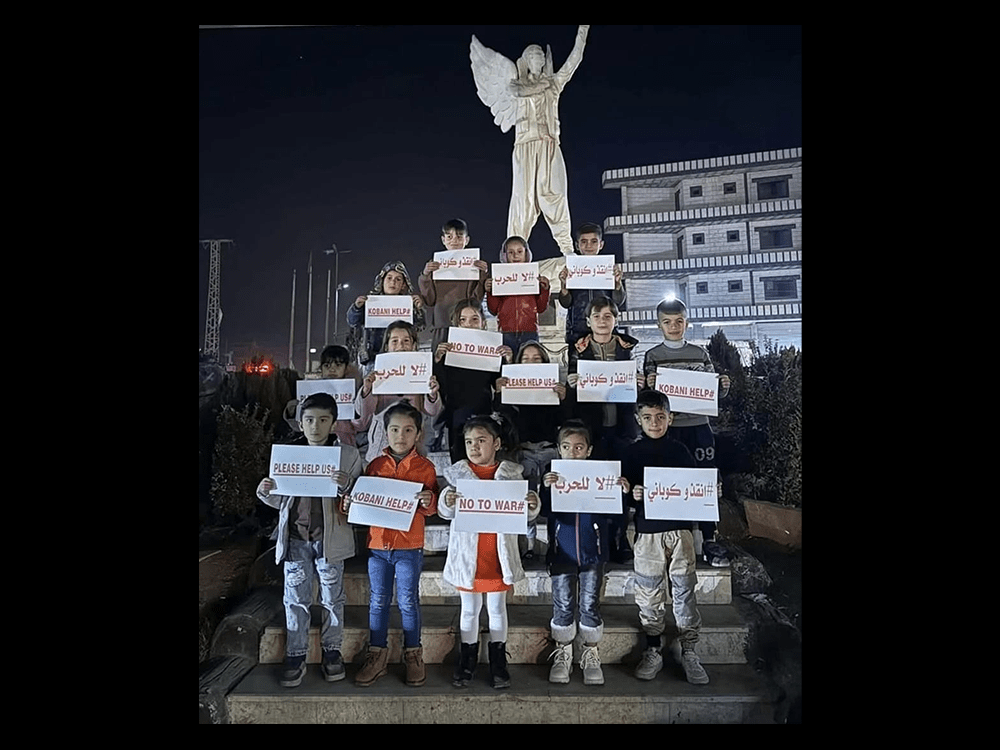
In 2014, Kobanê emerged onto international consciousness as the world watched a rag-tag army of women and men halt the advance of ISIS destruction. Today, Kobanê again faces an existential threat, and the one part of Syria that exemplifies the values of democratic coexistence and women’s rights that Western nations claim to support, faces the possibility of annihilation. So why, this time, are people so little aware?
The rapidity of events hasn’t helped. Even Turkey was surprised by the extent and speed of HTS’s success, but they proved flexible and ready to take advantage of the new situation and bring their long-cherished plans into effect. Israel, too, was quick to advance their own expansionist agenda. But other countries still seem dazed by what has happened, while commentators mistake wishful thinking for analysis. The Autonomous Administration claims that Western nations supported the HTS action in order to break the influence of Iran, Hezbollah, and Russia, and to facilitate the return of Syrian refugees; but these nations seem – not for the first time – to be unable to understand the forces they have unleashed. Concerns over events in Damascus and the nature of the new government have been allowed to eclipse Turkey’s parallel war against the Kurds.
While ISIS was seen as the incarnation of evil, Turkey is a NATO ally and a setting for summer holidays. In addition, its strategic and economic importance, and its control over refugee flows, make other countries reluctant to get in the way of its wishes.
Kurds, too, have been caught by surprise by the rapidity with which the situation has changed, especially after the deliberate confusion and raised hopes sown by the recent references to Abdullah Öcalan in the Turkish Parliament.
For some on the left, Kurdish reliance on US air power – without which they could not have survived – has taken the shine off their revolutionary credentials. They are regarded as pawns that allow America, as Assad claimed, to steal Syria’s oil. In fact, the oil wells – or what is left of them after Turkey’s bombardments – provide vital fuel and revenue for the region’s own shattered economy.
Every day for over a year, news feeds have been full f images of destruction from Gaza, and warnings of further destruction no longer have the impact they night have had. People have also been made suspicious by deliberately misleading stories about the Autonomous Administration’s relationship with Israel. Responding to a question about this when meeting with MEPs at the European Parliament, the Administration’s representative in Europe, Abdul-Karim Omar, noted that Israel’s pro-Kurd messages are designed to be heard by Turkey, and are not in the interest of the Kurds and the Autonomous Administration. The Administration is very careful of Arab sensibilities, and didn’t even allow Israeli press into their region. They have no relations with Israel, and they do not appreciate Israel’s fake and unhelpful messaging.
The new balance of power is summed up in an article in the supposedly liberal Guardian that is written by Hassan Hassan. The author is founder and editor of Newlines magazine, whose writers are generally close to the American state. Taking in the full geographic range of Turkey’s ambitious and aggressive foreign policy, the article concludes “The fall of the Assad regime in Syria marks the end of Iran’s long-feared ‘Shia crescent’ and the rise of Turkey’s ‘full moon’, reshaping the geopolitical landscape from the Horn of Africa to the Levant and Afghanistan. Recep Tayyip Erdoğan’s backing of the Syrian rebels has elevated Ankara to the status of a regional powerhouse, one whose influence now encircles all the major players in the region.” This is a chilling, and uncritical account of Turkey’s ruthless politics, and itself demonstrates a dismissal of Kurdish interests, along with any ethical dimension. Hassan echoes, without comment, Turkish portrayal of the Kurds as a security threat. The Guardian appears to have made no attempt to cover what is actually happening in North and East Syria.
While much of the Western press is guilty of failing the Kurds by omission, there is no shortage of people ready to spread false anti-Kurdish propaganda, both on social media and in the mainstream. Viewers who have come to rely on Qatar’s al Jazeera for news about Palestine are presented with a Through the Looking Glass world where it is the Kurds who sow division and the SNA that brings about peaceful coexistence, including for the persecuted Yazidis.
In the European Parliament
The inadequacy of Western political reaction was on display in the European Parliament debate on Syria on Tuesday. This did include several mentions of the Kurds, but there was very little recognition of the scale and seriousness of Turkey’s attacks. Many representatives from right wing parties were primarily concerned with sending back Syrian refugees, though also worried about Syrian Christians. Other members see everything only through the lens of the war in Ukraine. Despite acknowledgement of potential problems, there was generally a determined “cautious optimism”, as in the tone set by Kaja Kallas, the European Commission’s representative for Foreign Affairs and Security.
The President of the European Commission, Ursula Von der Leyen, met with Erdoğan in Turkey, and spoke at the plenary on Wednesday on her return, when she made no mention of the Kurds. She observed that “the fall of Assad is a cautionary tale about the limits of Russia’s power projection”, but Turkey’s growing dominance of the region seems to be of no concern. Indeed, she announced in Ankara that the EU was giving Turkey a further billion Euros under the EU-Turkey refugee agreement, and this seems not to have any strings attached that would prevent Turkey from turning millions of Kurds into more refugees. As Swedish Kurdish MEP Evin Incer told the press conference organised by the Parliament’s Kurdish Working Group, it was “shameful” that she “went to Turkey without any demands; just with a bag of money”.
International support
The situation is alarming, but the Kurds are not totally without support. The United States has repeatedly made clear that their alliance with the SDF is limited to the fight against ISIS, but they also recognise that the SDF is a vital part of that fight. They will recognise, too, that abandoning the Kurds a second time would seriously damage their own prestige. And despite all their bravado and other international links, Turkey places importance on their relationship with the United States and does not want to damage it.
On Wednesday the Pentagon announced that before the recent attacks they had already more than doubled the number of American troupes in the region to 2000.
Yesterday, Democratic Senator Chris Van Hollen and Republican Senator Lindsey Graham introduced the “Countering Turkish Aggression Act of 2024”, which would impose sanctions on Turkey for their refusal to accept a ceasefire and demilitarized zone.
And at a virtual press briefing, the US State Department said, “We are hopeful that Damascus and the SDF will begin a dialogue soon. We are working closely with our Kurdish partners and Turkey to support this process and encourage all parties to engage in constructive dialogue.” They still referred to Turkey’s “security concerns”, although they must know that the SDF has never threatened Turkey and has made clear that they have no intention of doing so; however, they combined this with “supporting the role of the SDF in the region.” Of course, Turkey could crush this hope tomorrow.
France has also been pushing negotiations to ensure a Kurdish role in the development of the new Syria, and the Dutch parliament has called for an immediate end to the attacks. Abdul-Karim Omar from the Autonomous Administration was invited to address both the Left Group and the Greens in the European Parliament this week, as well as meeting with individual MEPs. But a lot more needs to be and can be done to persuade the politicians that peace in North and East Syria is a vital and urgent issue that is key to the future of the country and the region – and that if they don’t act this will cost them public support.
(I will add the link to the Medya News website once it is loaded properly but there are problems at the moment)
 Sarah Glynn